FSMA Traceability Rule
Don't Wait for a Client Ultimatum to Take It Seriously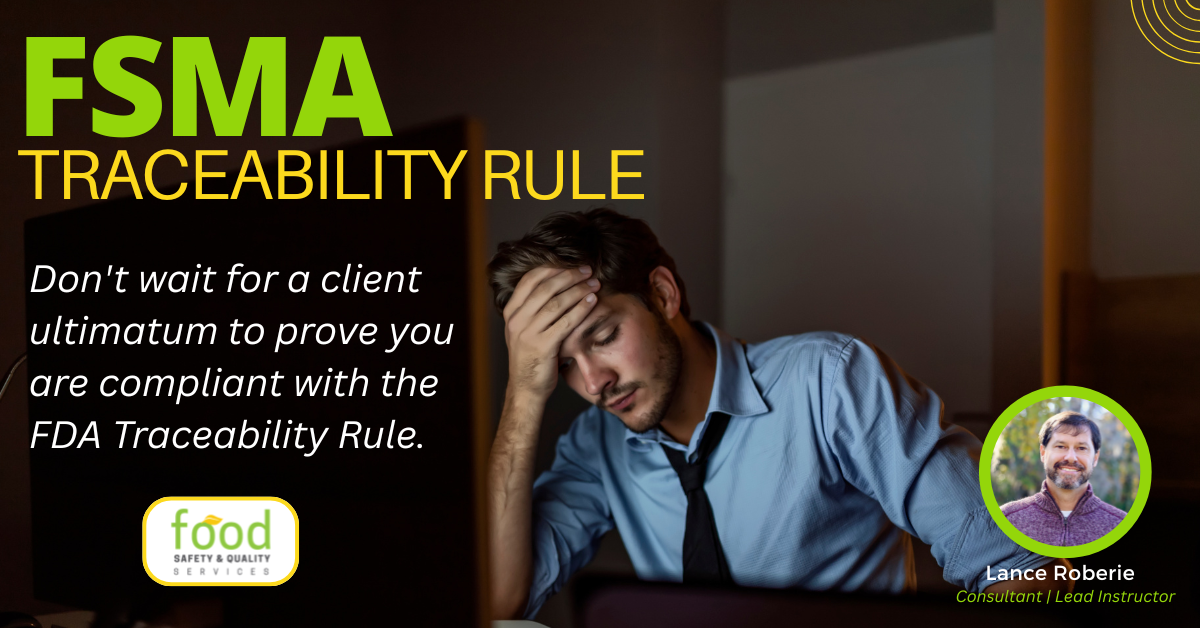
Imagine getting a call from one of your biggest accounts — a grocery chain, a warehouse club, or a foodservice distributor —telling you that your continued business with them now depends on proving you have completed an FTR training course and are working on becoming fully compliant with FSMA 204. No warning. No grace period. Just an expectation that you already have trained, qualified individuals on your staff.
I don't have to imagine that scenario because I've seen it happen firsthand. One of my clients received exactly that kind of call from a major customer. They were told, on short notice, that they needed to provide them with copies of FSPCA training certificates. Fortunately, we were able to get them where they needed to be before it impacted the relationship. But it was a stressful, last-minute scramble that could have been avoided entirely.
The facilities that are best prepared for the Traceability Rule aren't the ones reacting under pressure. They're the ones that invested the time to understand the requirements long before anyone asked.
What FSMA Section 204 Actually Requires
The FSMA Food Traceability Rule adds new recordkeeping requirements for companies that manufacture, process, pack, or hold foods on the FDA's Food Traceability List, commonly known as the FTL. That list includes many of the foods most associated with past outbreaks and recalls, from leafy greens and tomatoes to soft cheeses, shell eggs, and nut butters. If your facility touches any of these products, this rule likely applies to you, whether or not a customer has said anything about it yet.
At the core of the rule are two concepts that trip up a lot of facilities: critical tracking events, or CTEs, and key data elements, or KDEs. In plain terms, CTEs are the specific points where a product changes hands or form as it moves through the supply chain, and KDEs are the pieces of information you're required to capture and retain at each of those points. Getting this right isn't just about checking a regulatory box. It's about being able to trace a product quickly and accurately if something ever goes wrong, which protects public health and protects your business.
Why Waiting Is the Riskiest Option
The situation my client faced is becoming increasingly common.
As more grocery chains, distributors, retailers, and food manufacturers prepare for FSMA Section 204, they're placing greater expectations on their suppliers. Many aren't waiting for FDA enforcement to begin before updating their supplier requirements. Instead, they're asking vendors to demonstrate that they understand the rule and have a compliant traceability program already in place.
If you haven't developed a traceability plan, identified your KDEs for each CTE, or trained your team on what FSMA 204 actually requires, you could find yourself trying to solve those problems under an impossible deadline.
I'd much rather help you build a strong traceability program now than help you scramble after receiving an unexpected phone call from an important customer.
Don't Wait for Your Customers to Require Training
That's exactly why I teach this FDA Traceability Rule course.
During this live, instructor-led class, I'll walk you through the FDA's Food Traceability List, explain how to identify and document Critical Tracking Events and Key Data Elements, and show you how to develop a traceability plan that stands up during both customer audits and FDA inspections.
This isn't a lecture filled with regulatory jargon. It's practical training built around the real challenges food manufacturers face every day.
Whether you're a Food Safety or Quality Manager, PCQI, Supply Chain professional, Regulatory Affairs Specialist, IT Manager supporting traceability systems, grower, packer, importer, or operations leader, you'll leave with a clearer understanding of what the rule requires and how to implement it in your own facility.
You can learn more about the course curriculum, who should attend, and upcoming class dates on our FDA Traceability Rule Class page.
Don't Let a Customer Phone Call Be Your Wake-Up Call
My client was fortunate because they saw the writing on the wall and scheduled a course before it became critical.
Not every company will have that opportunity.
My advice is simple: be proactive instead of reactive. Invest in the training now, identify any gaps before your customers do, and build a traceability program you can be confident in.
Reserve your seat in the FSMA 204 class today, or explore our full lineup of upcoming food safety training courses. Whether you're preparing for the Traceability Rule or strengthening other areas of your food safety program, there's no better time to get ahead of the requirements than before someone else tells you that you have to.
About the author

Lance Roberie
Food Safety Consultant and TrainerLance Roberie has over 26 years of quality assurance and food safety experience within the food industry. Mr. Roberie holds the following certifications:
- Certified Food Safety HACCP Manager
- Preventative Controls for Human Foods (PCQI) Lead Instructor
- Meat & Poultry and Seafood HACCP Lead Instructor
- FSPCA Food Defense (IAVA) Lead Instructor
- ASQ Certified Manager of Quality & Organizational Excellence
- ServSafe Instructor and Exam Proctor
- GFSI Specialist
- ASQ Certified Food Safety and Quality Auditor
- Food Safety Council Member and Advisor for a leading food manufacturer
Lance and the Food Safety & Quality Services' training curriculum will advance your team's food safety knowledge through certified training, consulting, and "real life" industry scenarios.
upcoming Classes
November 4, 2026 08:00 AM - November 6, 2026 05:00 PM
December 1, 2026 08:00 AM - December 2, 2026 05:00 PM
October 29, 2026 08:00 AM - October 30, 2026 05:00 PM
Need a Food Safety Specialist?
Free 15 Minute Consultation.Learn how we helped Abita Brewing Company pass their first food safety audit with an A grade.